
75
Bundle 75: Heian Piety and Problems

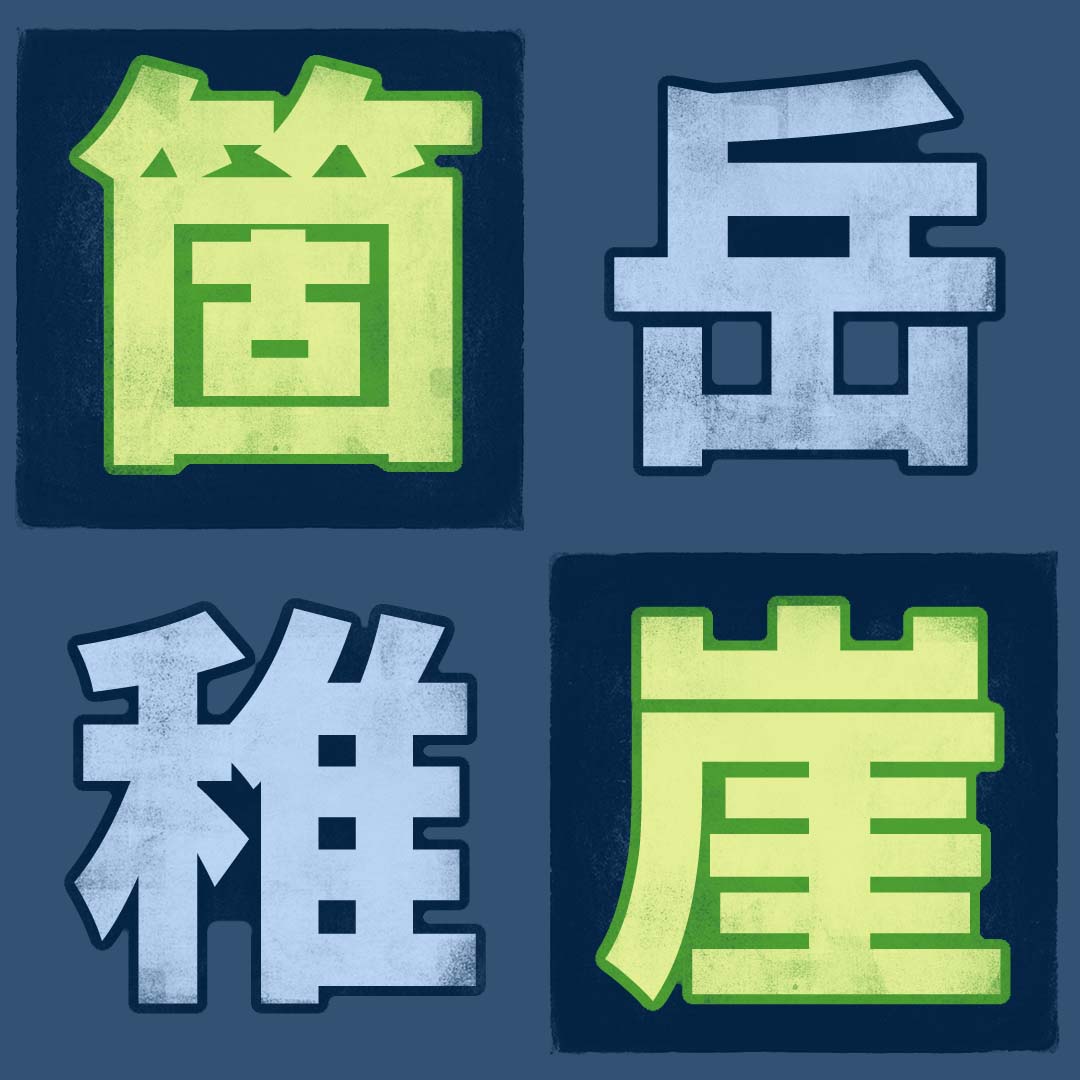
箇
item
JOK: 1054
Have you been confused about -箇 versus -個 as a counter? If so, you're not alone. This problem has existed for millennia! To complicate matters further, the Japanese generally replace -箇 with -か, -カ, -ヵ, -ケ, or -ヶ. And one doesn't even pronounce -ケ as け! This essay sorts out all such muddles and puts 箇 "in its place," showing how to use it to mean "place" and how to count places.
岳
mountain peak
JOK: 1082
See how Mount Fuji connects to a supercomputer that can save Japan. Find out how politicians hobbled science research for years. Discover a legend about how Fuji became taller than its rival. Learn to say, "Mount Yatsugatake is a range with eight peaks," "This dog is trained to save people in the mountains," "Mountain rescue teams are on standby," and "The mountaineer set out for the summit."
稚
immature
JOK: 1576
Although 稚 means 'immature' or 'childish,' this kanji often represents very young people who are no more to blame for their lack of readiness than half-baked bread is. Learn ways of saying things like "They were too naive to understand." Also discover the context behind kids in a festival procession who wear silk costumes and heavy makeup and who may be called "divine children."
崖
cliff
JOK: 1977
Do you know what it means figuratively when the Japanese refer to being on a cliff's edge? Can you say that a car went off a cliff or that a cliff is vertical? Can you refer to a landslide with a compound containing 崖? Do you know where to find giant Buddhas carved from rock faces? Do you know which cliffs are famous in Japan and why? If you read the essay, you'll soon know all this!
Kanshudo is your AI Japanese tutor, and your constant companion on the road to mastery of the Japanese language.
To get started learning Japanese, just follow the study recommendations on your Dashboard.
You can use Quick search (accessible using the icon at the top of every page) to look up any Japanese word, kanji or grammar point, as well as to find anything on Kanshudo quickly.
For an overview, take the tour.
