
72
Bundle 72: Heian-Era Clans in Control

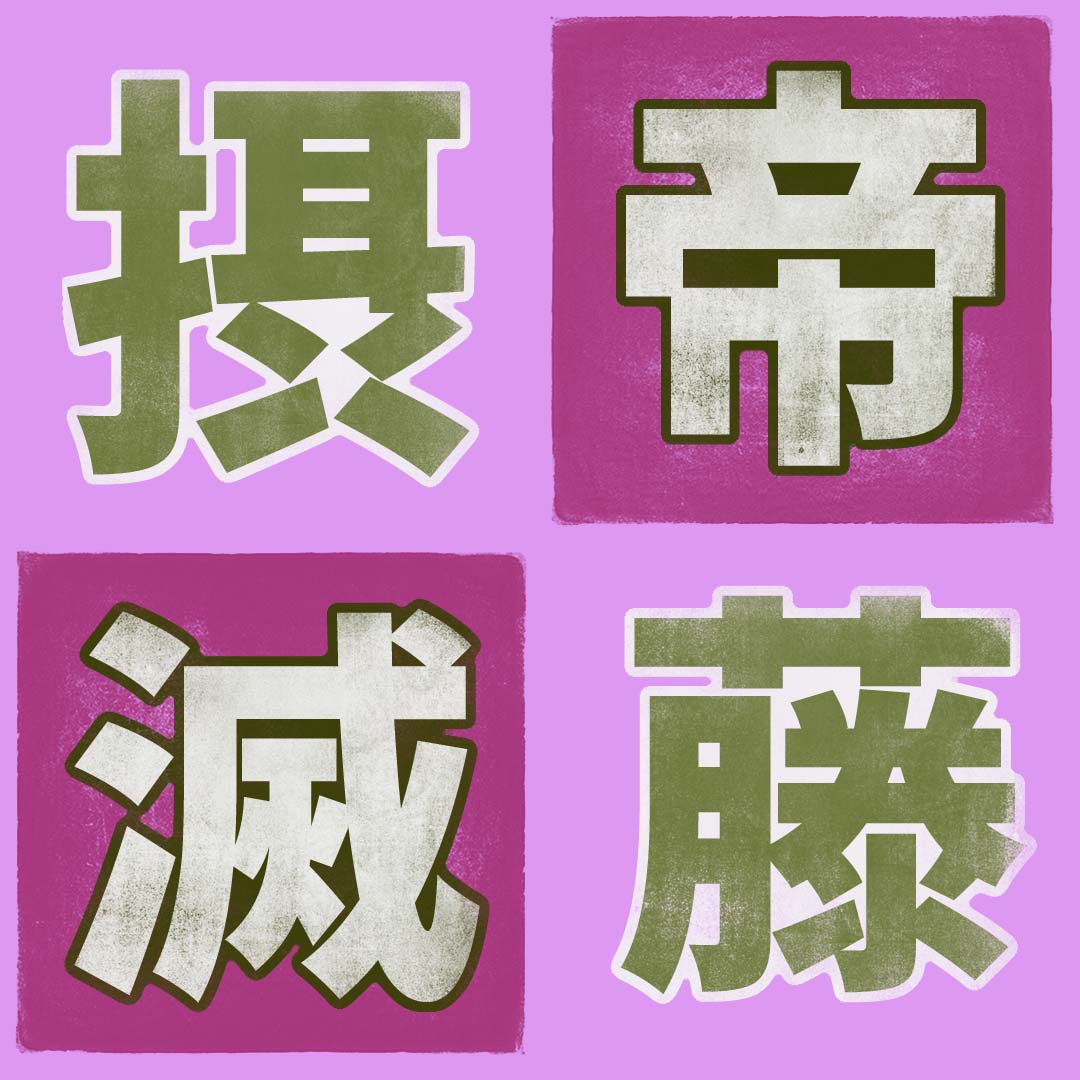
摂
absorb
JOK: 1489
See why the Japanese refer to Mr. Celsius when citing temperatures. Find out who used to act in place of the emperor. Also learn to say, "Good nutrition is vital for a very young child's growth," "Jim had to cut down on his sugar intake," "Taking care of one's health is the secret to longevity," and "An excessive lifestyle throws hormones out of balance."
帝
sovereign
JOK: 1616
Find out why some people call Japan にっぽん, how the mikado kept himself busy centuries ago when he had no power, and how to address the emperor properly if you ever meet! The essay also examines how the old Empire of Japan has influenced the country today, from traces of imperial words in the contemporary language to Japanese feelings about what happened in the past.
滅
destroy
JOK: 1848
With 滅 you can cut a wide swath of destruction. A generous supply of sample sentences will teach you to talk about everything from wiping out whole towns to eradicating diseases, as well as the fall of the Roman empire, the crumbling of traditions, and the extinction of species. You'll also learn terms for "recklessness" and "chaos," even finding out how to say "I'll make it up to you."
藤
wisteria
JOK: 2078
From wisteria-viewing parties to hair ornaments to a type of doll and dance, wisteria has left its mark on Japanese culture. The 藤 kanji appears in the names of colors, plants, and animals, some with no connection to this vine. Above all, one finds 藤 in people's names. Thus, we have the Fujiwara period of art history, the Fujiwara effect, and the Fujita scale of tornado intensity.
Kanshudo is your AI Japanese tutor, and your constant companion on the road to mastery of the Japanese language.
To get started learning Japanese, just follow the study recommendations on your Dashboard.
You can use Quick search (accessible using the icon at the top of every page) to look up any Japanese word, kanji or grammar point, as well as to find anything on Kanshudo quickly.
For an overview, take the tour.
