
80
Bundle 80: Warring States Era: The Legacy of Militarism

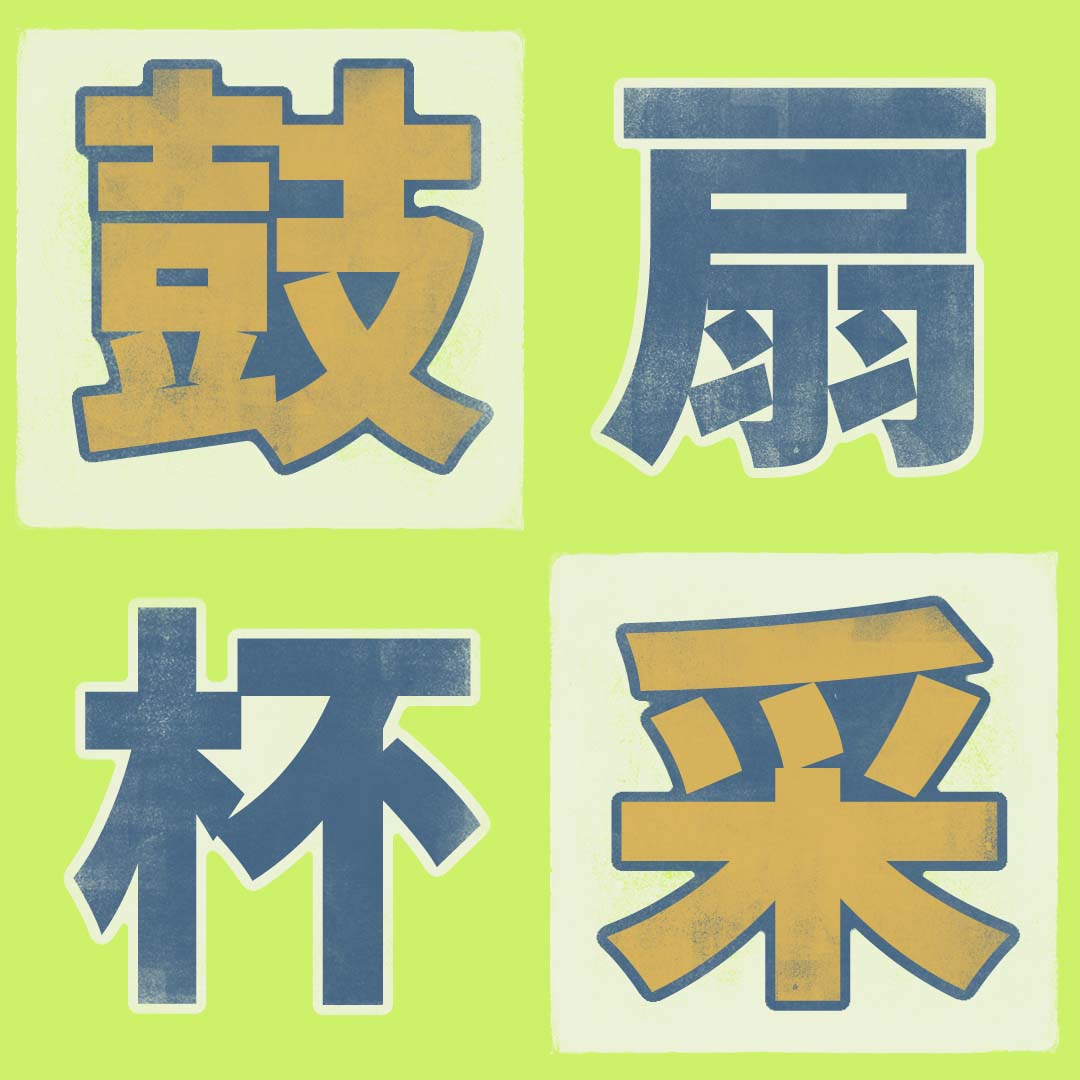
鼓
hand drum
JOK: 1234
Learn about a wide range of Japanese drums, including the small, ropy type played on the shoulder. See what "taiko" means in Japan versus abroad, and learn how ensemble drumming was created quite recently. Also discover traditional drumming contexts, from the battlefield to the shrine to the theater. Find out which "drums" you can consume and where drums lie in the human body!
扇
folding fan
JOK: 1492
You might be envisioning a handheld fan as a dainty item held by a dainty woman, but war commanders used to hold fans, and fans have served as weapons! Far from being confined to a genteel world, 扇 plays a role in words about instigating trouble. Learn about two shapes of fans and see how they influence animal and plant names, as well as descriptions of many everyday objects.
杯
cup
JOK: 1685
If you invite someone out for drinks, use saké cups, make a toast, and count how many drinks you've had, 杯 will come in very handy. And if you drink till you're tipsy and full in a cheap drinking spot filled with people, you'll need 杯 four more times. As if this kanji weren't useful enough, you can also use it when counting octopi (which you might do after enough drinks)!
采
die; dice
JOK: 2015
Find out about a kanji that carries meanings as disparate as “dice” and “appearance” while popping up in terms for “baton” and “cheering.” Learn to discuss leadership roles and discover a link between dice and food. See ways of saying, “We rolled dice to decide whose turn it was,” “She bowed to acknowledge their cheering,” and “He has a slightly foreign appearance.”
Kanshudo is your AI Japanese tutor, and your constant companion on the road to mastery of the Japanese language.
To get started learning Japanese, just follow the study recommendations on your Dashboard.
You can use Quick search (accessible using the icon at the top of every page) to look up any Japanese word, kanji or grammar point, as well as to find anything on Kanshudo quickly.
For an overview, take the tour.
