部
Components

傾 means 'tilt'

Animation / stroke order not available.
LOG IN to view this kanji's mnemonic
Strokes : 13    Frequency: 1019   JLPT: N2    Usefulness: 4    Study set: 4-13    Grade: 8   Intermediate lesson: 47    Beginner lesson: -   Begins 42 words   Used in 73 words   Used in 13 names   Not used as a component
Jōyō (常用)
On
   ケイ
Kun
   かたむく   かたむける to tilt, to incline, to lean
Kun    かしげる to incline (one's head)   かたぶく   かたげる
A Joy o' Kanji essay is available for 傾 - click the badge to download
Learn to discuss trends, as in "Students these days tend to use social media." Find out how to refer to slopes, saying, "The land slopes gently toward the river." See what it means figuratively to lean forward or to the right. Learn to talk about concentrating energy, as in, "He put his heart and soul into it." And find out how to tilt your head to the side in curiosity. It's not just for dogs!
The essay is also included in the following Thematic Bundles
62
Hopelessly Devoted
凝 傾 酔 陶
With these four kanji, you can lose yourself: You can put your heart and soul into pursuing a goal. You can become so passionate that you're obsessed. You can become intoxicated by an onsen or fascinated by music—even drunk on your own charms. You can admire a teacher so much that you're hopelessly devoted. Is all of this positive or negative? On the plus side, a fanatical mindset enables you to create elaborate things, feel deeply, commit fully, and master skills. On the minus side, you will likely annoy others as you slide into monomania and perfectionism!
99
Edo Era: Samurai Style
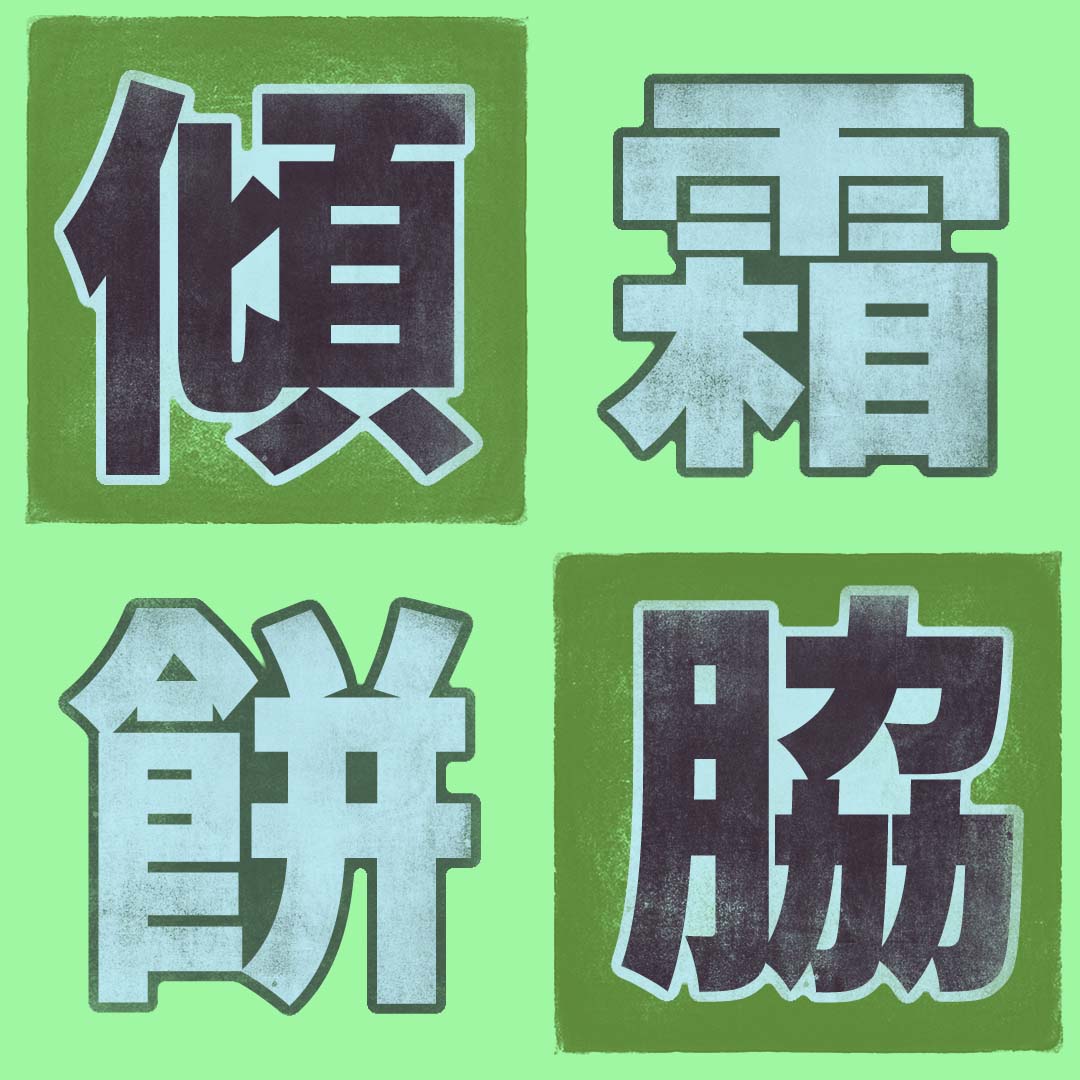
傾 霜 餅 脇
What a figure the samurai must have cut in the Edo era (1603–1867). As these essays explain, men shaved the tops of their heads. Kabukimono (samurai gangsters) had even stranger hairstyles, plus eye-catching clothes and behavior so eccentric that people often translate "kabukimono" as "the crazy ones." Samurai wore two swords—one large and one small—whereas commoners had only small ones. In urban areas, the rebellious kabukimono were both hated for their lawlessness and admired for their manliness. Samurai culture flourished so much that people created a rectangular mochi and playfully named it with a samurai allusion!
⿰  化 change  頁 page  
Explore these components visually on The Kanji Map ⇗
貨 freight  
LOG IN to view kanji mastery data
LOG IN to view your flashcards
In the most useful 10,000 words in Japanese, 傾 is used 4 times, read 2 ways.
Across all words in Japanese, 傾 is used 55 times, read 3 ways.
Showing:
ケイ : 38 words FIND ALL
け い こ う 0
tendency; trend; inclination
(click the word for examples and links)
かたむく : 13 words FIND ALL
か た む け る 4
ichidan verb, transitive verb
1. to incline; to lean; to tip; to tilt; to slant; to bend; to list
2. to devote oneself to; to concentrate on; to pour one's energy into
(click the word to view an additional 2 meanings, examples and links)
かしげる : 4 words FIND ALL
か し げ る 3
ichidan verb, transitive verb
to lean; to incline; to tilt; to slant
(click the word to view an additional 1 reading, useful expressions, examples and links)
Additional less common words include 傾 but readings have not yet been categorized.
Henshall: 1201  Joy o' Kanji : 1201  Key to Kanji: - 

Cascading kanji view

傾
ケイ   かたむく    かたむける to tilt, to incline, to lean   
Please LOG IN to view this kanji's mnemonic
化
カ   ケ   ばける to change   
Please LOG IN to view this kanji's mnemonic
亻
ジン   ニン   ひと man   
匕
さじ spoon   
頁
ページ page, leaf of a book   
Please LOG IN to view this kanji's mnemonic
丆
whereupon one
Please LOG IN to view this kanji's mnemonic
ノ
katakana 'no'; whereupon; splitting away from
一
イチ   イツ   ひとつ    ひと- one   
貝
かい shellfish   
Please LOG IN to view this kanji's mnemonic
ハ
katakana 'ha'; eight
目
ボク   モク   eye   ま-    め    
Problem with this kanji? Question or comment? Please CONTACT US.

Kanshudo is your AI Japanese tutor, and your constant companion on the road to mastery of the Japanese language. To get started learning Japanese, just follow the study recommendations on your Dashboard. You can use Quick search (accessible using the icon at the top of every page) to look up any Japanese word, kanji or grammar point, as well as to find anything on Kanshudo quickly. For an overview, take the tour.
Search results include information from a variety of sources, including Kanshudo (kanji mnemonics, kanji readings, kanji components, vocab and name frequency data, grammar points, examples), JMdict (vocabulary), Tatoeba (examples), Enamdict (names), KanjiVG (kanji animations and stroke order), and Joy o' Kanji (kanji and radical synopses). Translations provided by Google's Neural Machine Translation engine. For more information see credits.
×